

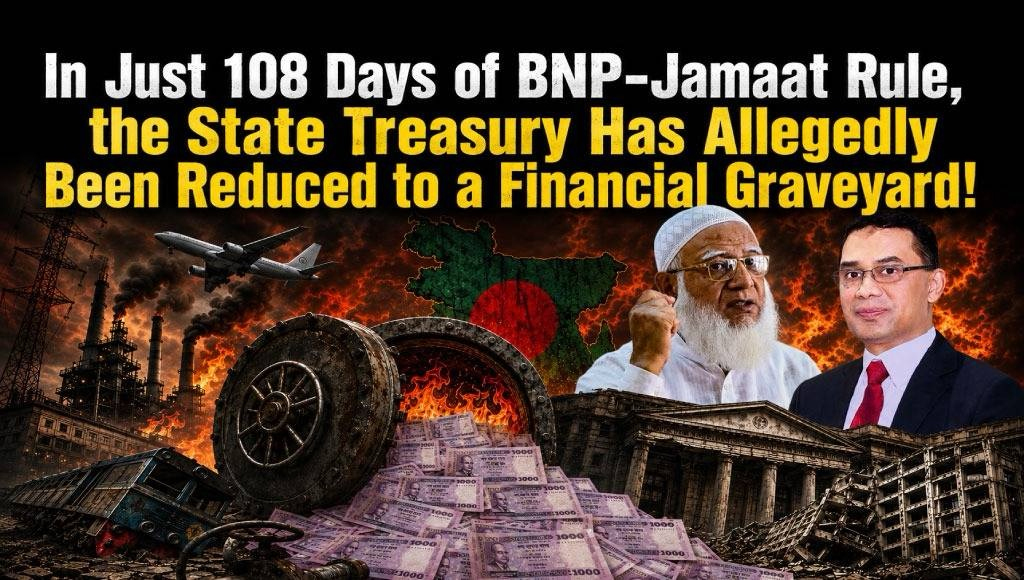
Empty Treasury in 108 Days: State Institutions Burdened with Tk 8.33tn Debt!

Less than five months after Yunus’ interim administration left office, the country’s state treasury appears to have reached a critical financial low. The latest figures released by the Ministry of Finance paint a startling picture. A total of 122 state-owned institutions are burdened with liabilities amounting to Tk 8.33 trillion (Tk 833,000 crore). Ironically, a significant portion of these debts is owed to the government itself, creating a situation where money is effectively being shifted from one government pocket to another. Citizens are left wondering what kind of crisis the country is being forced to endure.

From the power and energy sectors to aviation and industry, the effects of alleged mismanagement and financial irregularities are said to be visible across the board. After only 108 working days, the BNP-Jamaat coalition government has, according to the article, set a new benchmark for poor governance. It claims that Yunus left behind a massive financial burden through commitments amounting to hundreds of thousands of crores of taka, and that the current government is now struggling to honor those obligations, pushing the country toward insolvency. Officials reportedly estimate that the total liabilities have now exceeded Tk 10 trillion.

Consider the implications: to repay these debts, the government may have to reduce its development budget. That would mean less funding for your children’s schools, hospitals in your community, and essential road infrastructure, with those resources instead disappearing into what the article describes as a financial black hole. A substantial share of the non-performing loans held by state-owned banks is linked to these financially distressed public institutions. As a result, lending to the private sector has slowed significantly, employment growth has stalled, and investment has dried up.

The article further argues that the liabilities left behind by Yunus are now being compounded by the BNP-Jamaat government. It recalls the 2001-2006 period, alleging that state assets were systematically looted during that time, and concludes by suggesting that the country is witnessing the return of that same dark chapter.

Less than five months after Yunus’ interim administration left office, the country’s state treasury appears to have reached a critical financial low. The latest figures released by the Ministry of Finance paint a startling picture. A total of 122 state-owned institutions are burdened with liabilities amounting to Tk 8.33 trillion (Tk 833,000 crore). Ironically, a significant portion of these debts is owed to the government itself, creating a situation where money is effectively being shifted from one government pocket to another. Citizens are left wondering what kind of crisis the country is being forced to endure.

From the power and energy sectors to aviation and industry, the effects of alleged mismanagement and financial irregularities are said to be visible across the board. After only 108 working days, the BNP-Jamaat coalition government has, according to the article, set a new benchmark for poor governance. It claims that Yunus left behind a massive financial burden through commitments amounting to hundreds of thousands of crores of taka, and that the current government is now struggling to honor those obligations, pushing the country toward insolvency. Officials reportedly estimate that the total liabilities have now exceeded Tk 10 trillion.

Consider the implications: to repay these debts, the government may have to reduce its development budget. That would mean less funding for your children’s schools, hospitals in your community, and essential road infrastructure, with those resources instead disappearing into what the article describes as a financial black hole. A substantial share of the non-performing loans held by state-owned banks is linked to these financially distressed public institutions. As a result, lending to the private sector has slowed significantly, employment growth has stalled, and investment has dried up.

The article further argues that the liabilities left behind by Yunus are now being compounded by the BNP-Jamaat government. It recalls the 2001-2006 period, alleging that state assets were systematically looted during that time, and concludes by suggesting that the country is witnessing the return of that same dark chapter.

আরো পড়ুন

LATEST