
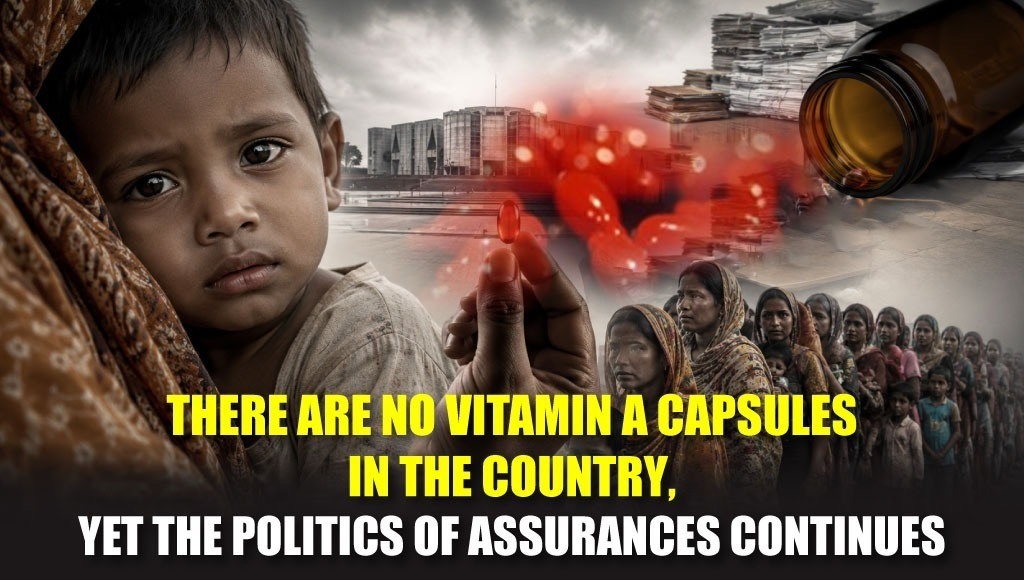
There Are No Vitamin A Capsules in the Country, Yet the Politics of Assurances Continues

For fourteen months, millions of children across Bangladesh have been unable to receive a simple capsule that is supposed to be administered twice a year. It is inexpensive, readily preventable, and crucial for protecting children from conditions such as night blindness, measles, diarrhoea, and anaemia. The fact that the state has failed to carry out such a basic public health intervention reflects the broader state of Bangladesh’s administrative system over the past year and a half.

The roots of this crisis lie in the period of the interim government led by Yunus. After the operational plan for the health sector expired in June 2024, an initiative was taken to procure Vitamin A capsules through a tender process. However, the ministry itself disagreed with the tender and ultimately cancelled the entire procurement process. A new decision was then made to obtain the capsules from UNICEF through a separate agreement. Yet months passed before that decision could be finalized, and in the meantime the scheduled September 2025 campaign was completely missed. In other words, the government halted an ongoing program and chose a new path, but moved so slowly that children were left caught in the middle.

Following the February election, the BNP-Jamaat coalition came to power. While they inherited this crisis, they also inherited the responsibility to resolve it. Yet the same delays appear to be continuing. Just last month, the Health Minister publicly assured the nation that more than ten million capsules would arrive by 10 June. The statement was intended to reassure the public. However, 10 June passed without any capsules arriving. At the same time, the Director of the National Nutrition Services questioned that timeline and appeared unwilling to acknowledge that the campaign had effectively been suspended. When two different branches of the same ministry provide conflicting information, it reveals a serious lack of coordination.

Even more striking is the language being used. Phrases such as “efforts are underway,” “there is a slight delay,” and “Inshallah, we will do it” are being used to describe the future of a national public health program involving the immune protection of millions of children. When officials cannot confidently commit even to a specific date, such as 15 June, and instead announce a “possible” campaign date of 27 June based on uncertainty, it becomes clear that the process is being driven by hope and assumptions rather than firm planning.

Perhaps the most troubling aspect is the absence of any sense of urgency. Night blindness was once virtually eliminated in Bangladesh largely because of this very program. That achievement is now at risk, yet there has been no major national discussion, no widely reported emergency meetings, and no acceptance of responsibility. Governments have changed and political leadership has shifted, but the state’s indifference toward the health of ordinary children appears unchanged.

Eventually, the capsules may arrive and the campaign may finally take place. But the fourteen months that have already passed cannot be recovered. Children who developed Vitamin A deficiencies during this period, and whose immune systems remained vulnerable, will never be compensated for the delay. No one is likely to account for those losses, and no one may even ask. That may be the saddest reality of all.

For fourteen months, millions of children across Bangladesh have been unable to receive a simple capsule that is supposed to be administered twice a year. It is inexpensive, readily preventable, and crucial for protecting children from conditions such as night blindness, measles, diarrhoea, and anaemia. The fact that the state has failed to carry out such a basic public health intervention reflects the broader state of Bangladesh’s administrative system over the past year and a half.

The roots of this crisis lie in the period of the interim government led by Yunus. After the operational plan for the health sector expired in June 2024, an initiative was taken to procure Vitamin A capsules through a tender process. However, the ministry itself disagreed with the tender and ultimately cancelled the entire procurement process. A new decision was then made to obtain the capsules from UNICEF through a separate agreement. Yet months passed before that decision could be finalized, and in the meantime the scheduled September 2025 campaign was completely missed. In other words, the government halted an ongoing program and chose a new path, but moved so slowly that children were left caught in the middle.

Following the February election, the BNP-Jamaat coalition came to power. While they inherited this crisis, they also inherited the responsibility to resolve it. Yet the same delays appear to be continuing. Just last month, the Health Minister publicly assured the nation that more than ten million capsules would arrive by 10 June. The statement was intended to reassure the public. However, 10 June passed without any capsules arriving. At the same time, the Director of the National Nutrition Services questioned that timeline and appeared unwilling to acknowledge that the campaign had effectively been suspended. When two different branches of the same ministry provide conflicting information, it reveals a serious lack of coordination.

Even more striking is the language being used. Phrases such as “efforts are underway,” “there is a slight delay,” and “Inshallah, we will do it” are being used to describe the future of a national public health program involving the immune protection of millions of children. When officials cannot confidently commit even to a specific date, such as 15 June, and instead announce a “possible” campaign date of 27 June based on uncertainty, it becomes clear that the process is being driven by hope and assumptions rather than firm planning.

Perhaps the most troubling aspect is the absence of any sense of urgency. Night blindness was once virtually eliminated in Bangladesh largely because of this very program. That achievement is now at risk, yet there has been no major national discussion, no widely reported emergency meetings, and no acceptance of responsibility. Governments have changed and political leadership has shifted, but the state’s indifference toward the health of ordinary children appears unchanged.

Eventually, the capsules may arrive and the campaign may finally take place. But the fourteen months that have already passed cannot be recovered. Children who developed Vitamin A deficiencies during this period, and whose immune systems remained vulnerable, will never be compensated for the delay. No one is likely to account for those losses, and no one may even ask. That may be the saddest reality of all.

আরো পড়ুন

LATEST