

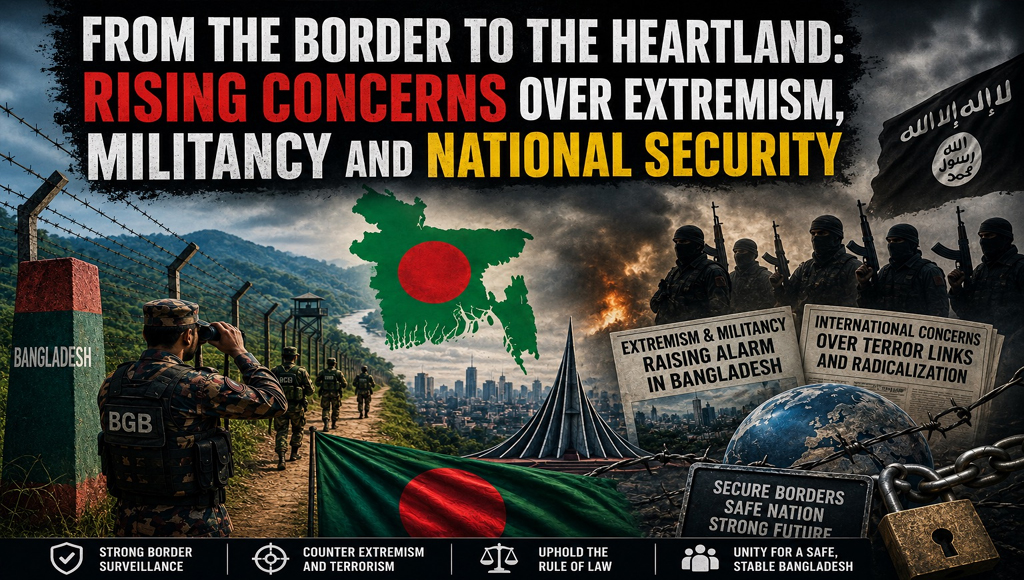
From the Border to the Heartland: Rising Concerns Over Extremism, Militancy, and National Security

Fresh concerns have emerged regarding Bangladesh’s border and internal security situation. On one hand, various claims and discussions have surfaced about the activities of the Myanmar-based armed group, the Khumi People’s Force (KPF), in areas bordering the Chittagong Hill Tracts. On the other hand, incidents and allegations related to extremism and militancy within the country have also generated public anxiety. As a result, questions are being raised about everything from border security to national stability.

According to various reports and claims, KPF members have crossed into Bangladesh and are attempting to expand their activities in remote areas of Ruma and Thanchi in Bandarban, as well as Bilaichhari in Rangamati and certain parts of Khagrachhari. There have even been discussions in various circles regarding claims that messages were sent to the Border Guard Bangladesh (BGB) seeking permission for unrestricted movement in border areas.

In the past, several armed groups operating in the hill tracts—including Kuki-Chin groups, the United People’s Democratic Front (UPDF), the Parbatya Chattagram Jana Samhati Samiti (JSS), and the Arakan Army—have faced allegations of kidnapping, extortion, enforced disappearances, and taking tourists hostage. Consequently, concerns surrounding the KPF have heightened anxiety among local residents and travelers alike. In particular, discussions about security risks associated with traveling to the hilly regions of Ruma and Thanchi during the monsoon season have intensified.

At the same time, the names of various extremist and militant organizations, including ISIS, Hizb ut-Tahrir, and Ansarullah Bangla Team, have periodically appeared in news reports and public discussions. International media outlets have also published reports concerning extremism and militancy in Bangladesh. Critics argue that the spread of extremist ideologies could be harmful to social harmony, national security, and Bangladesh’s international reputation.

Some analysts believe that allegations involving Bangladeshi citizens in conflict zones such as Pakistan, Afghanistan, Türkiye, Iraq, Yemen, and Russia are creating negative perceptions internationally. Concerns have also been raised that such developments could contribute to increased suspicion toward Bangladeshi workers in the global labor market.

International media have occasionally reported allegations involving Bangladeshi nationals participating in foreign conflicts. Critics further claim that insufficient attention has been given to identifying the individuals or organizations behind such activities, allowing agents linked to international terrorist and militant networks to continue operating.

Extremism and militancy are not beneficial for any country, society, or religion. Critics argue that effective measures to control these threats have not been visible during the Yunus administration. They warn that extremist ideologies have spread within society and that failure to address them could eventually push Bangladesh toward becoming a more fundamentalist and militancy-prone state, similar to Pakistan or Afghanistan.

Meanwhile, concerns have also been raised in the political sphere regarding the resurgence of forces perceived as opposed to the spirit of independence and allegations that political groups accused of supporting militancy have been allowed to operate freely. At the same time, there have been accusations that the political rights of parties supporting the ideals of independence are being curtailed. Criticism has also emerged over alleged disrespect toward the Liberation War and freedom fighters in parliamentary discussions, as well as the honoring—either officially or socially—of individuals linked to the events of July and August. Many citizens across the country have expressed concern over these issues.

To safeguard Bangladesh’s sovereignty, border security, and international standing, it is essential to strengthen border surveillance, counter extremism and militancy, uphold the rule of law, and reinforce national unity.

Any security threat at the border, if not addressed in a timely manner, can eventually spread into the country’s interior. Therefore, coordinated efforts by the state, law enforcement agencies, and civil society are crucial to building a safe, stable, and prosperous Bangladesh.

Fresh concerns have emerged regarding Bangladesh’s border and internal security situation. On one hand, various claims and discussions have surfaced about the activities of the Myanmar-based armed group, the Khumi People’s Force (KPF), in areas bordering the Chittagong Hill Tracts. On the other hand, incidents and allegations related to extremism and militancy within the country have also generated public anxiety. As a result, questions are being raised about everything from border security to national stability.

According to various reports and claims, KPF members have crossed into Bangladesh and are attempting to expand their activities in remote areas of Ruma and Thanchi in Bandarban, as well as Bilaichhari in Rangamati and certain parts of Khagrachhari. There have even been discussions in various circles regarding claims that messages were sent to the Border Guard Bangladesh (BGB) seeking permission for unrestricted movement in border areas.

In the past, several armed groups operating in the hill tracts—including Kuki-Chin groups, the United People’s Democratic Front (UPDF), the Parbatya Chattagram Jana Samhati Samiti (JSS), and the Arakan Army—have faced allegations of kidnapping, extortion, enforced disappearances, and taking tourists hostage. Consequently, concerns surrounding the KPF have heightened anxiety among local residents and travelers alike. In particular, discussions about security risks associated with traveling to the hilly regions of Ruma and Thanchi during the monsoon season have intensified.

At the same time, the names of various extremist and militant organizations, including ISIS, Hizb ut-Tahrir, and Ansarullah Bangla Team, have periodically appeared in news reports and public discussions. International media outlets have also published reports concerning extremism and militancy in Bangladesh. Critics argue that the spread of extremist ideologies could be harmful to social harmony, national security, and Bangladesh’s international reputation.

Some analysts believe that allegations involving Bangladeshi citizens in conflict zones such as Pakistan, Afghanistan, Türkiye, Iraq, Yemen, and Russia are creating negative perceptions internationally. Concerns have also been raised that such developments could contribute to increased suspicion toward Bangladeshi workers in the global labor market.

International media have occasionally reported allegations involving Bangladeshi nationals participating in foreign conflicts. Critics further claim that insufficient attention has been given to identifying the individuals or organizations behind such activities, allowing agents linked to international terrorist and militant networks to continue operating.

Extremism and militancy are not beneficial for any country, society, or religion. Critics argue that effective measures to control these threats have not been visible during the Yunus administration. They warn that extremist ideologies have spread within society and that failure to address them could eventually push Bangladesh toward becoming a more fundamentalist and militancy-prone state, similar to Pakistan or Afghanistan.

Meanwhile, concerns have also been raised in the political sphere regarding the resurgence of forces perceived as opposed to the spirit of independence and allegations that political groups accused of supporting militancy have been allowed to operate freely. At the same time, there have been accusations that the political rights of parties supporting the ideals of independence are being curtailed. Criticism has also emerged over alleged disrespect toward the Liberation War and freedom fighters in parliamentary discussions, as well as the honoring—either officially or socially—of individuals linked to the events of July and August. Many citizens across the country have expressed concern over these issues.

To safeguard Bangladesh’s sovereignty, border security, and international standing, it is essential to strengthen border surveillance, counter extremism and militancy, uphold the rule of law, and reinforce national unity.

Any security threat at the border, if not addressed in a timely manner, can eventually spread into the country’s interior. Therefore, coordinated efforts by the state, law enforcement agencies, and civil society are crucial to building a safe, stable, and prosperous Bangladesh.

আরো পড়ুন

LATEST