

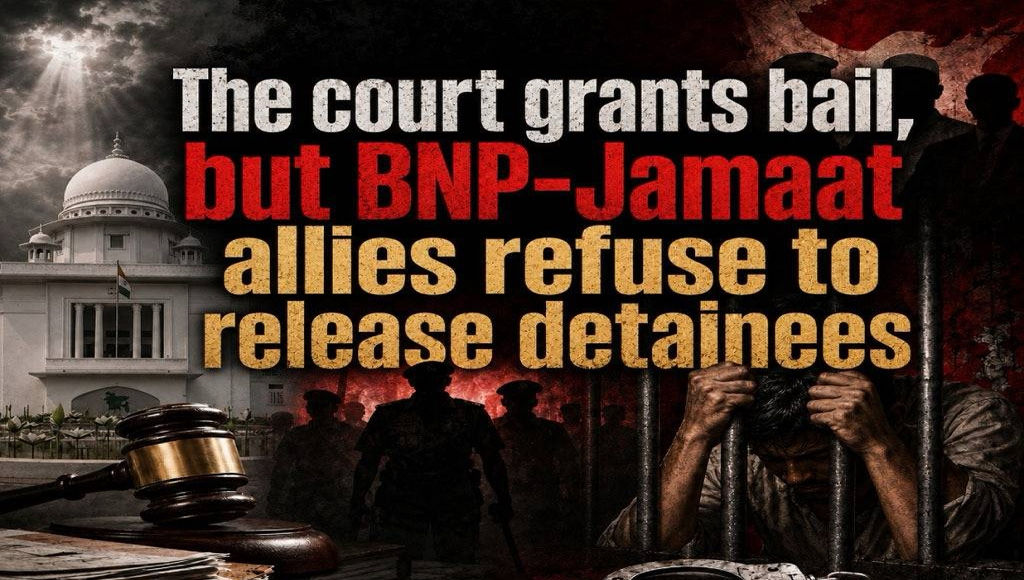

Getting bail in one case is supposed to mean freedom for the accused. But in today’s Bangladesh, that has become the biggest trap of all. Before the bail documents even leave the courtroom, word is passed from the prosecution division to the police station. The police immediately prepare a new case file. The accused person’s name is not in the complaint, they were not present at the scene, and no witness identifies them. Yet they are still labeled “suspects,” shown as arrested again, and kept in jail for months. This game is being played openly in Bangladesh in 2026, where power is now controlled by BNP and Jamaat.
Istiaq Milon from Kurigram, Al Maruf from Keraniganj, and Abdul Hakim from Nilphamari. None of them are active politicians. None hold any political position. Istiaq came to Dhaka looking for work, while Maruf used to tutor students. Both were dragged by police from one case into another. Istiaq says that even after receiving bail in his second case, he was detained in prison under the excuse of “observation” until money was paid. Maruf’s brother says that because they could not pay, he has remained behind bars for one year and three months. Abdul Hakim’s condition is even worse. After receiving bail in three cases in Dhaka, he was shown arrested in two additional cases from Nilphamari and taken back to his home district. The only reason: he once belonged to Chhatra League.
This is now Bangladesh’s justice system. It is no longer about cases and investigations, but bargaining and negotiations. Lawyer Farzana Yasmin Rakhi put it plainly: unless the police station is “managed,” it is almost impossible to stop these shown arrests. Even lawyers admit that for every shown arrest officially recorded, many more people are pressured into settlements through fear alone. Just when a family begins to hope after bail is granted, a call comes from the police station: cooperate and things can be arranged, refuse and another case will appear. This is the commercialized form of police “clearance.”
Dr. Shahdeen Malik said that keeping someone jailed before conviction is not the practice of a civilized country. Former district judge Shahjahan Saju said that if a person’s name is absent from the FIR, and no statement under Sections 164 or 161 links them to the crime, then showing them arrested is a gross abuse of the law. What these experts say is true in legal textbooks, but false in reality. Reality is controlled by the same police force whose political masters are now BNP and Jamaat.
Remember the BNP-Jamaat rule of 2001–06? The marks of that era are clearly visible in today’s police behavior. Back then, police stations became factories of corruption, and the police acted as a partisan enforcement force. Extortion, disappearances, killings, and land grabbing were all part of the political culture of that period. Today it is the same police, the same stations, the same prosecution division. Only the people at the top have changed. What BNP-Jamaat did in the name of law between 2001 and 2006 is now being repeated again, only this time in a more refined and systematic way. The machinery of shown arrests existed then too, but now it has been sharpened to crush ordinary and politically unaffiliated people.
Ironically, a deputy commissioner of the DMP prosecution division claims they merely present applications before the court. But where do those applications come from? From the police stations. And who instructs the stations to prepare them? The same political offices now controlled by BNP and Jamaat. The cycle is obvious. Lists of accused persons who receive bail are first sent to police stations, followed by new case arrangements. Who prepares those lists? Who decides whose names stay on them? The people making those decisions are the real judges now. The eyes of the law are blind.
The Jamaat that formed Razakar militias in 1971, and the BNP that emerged from military barracks in the 1980s and institutionalized a culture of disappearances and killings, now preside over a police force that has turned shown arrests into an industry. Cases are filed, bail becomes meaningless, and release depends on unofficial payments. Those without money remain jailed, while those who can pay walk free. This is not justice, it is organized extortion.
Young men like Maruf are rotting in prison for over a year, despite never being named in any FIR. Istiaq remained detained after bail until his family managed the police GR branch. These are now everyday scenes in Bangladesh. Behind this reality stands the BNP-Jamaat government of 2026, accused of dismantling the rule of law and turning police stations into centers of extortion, with ordinary citizens paying the price.