

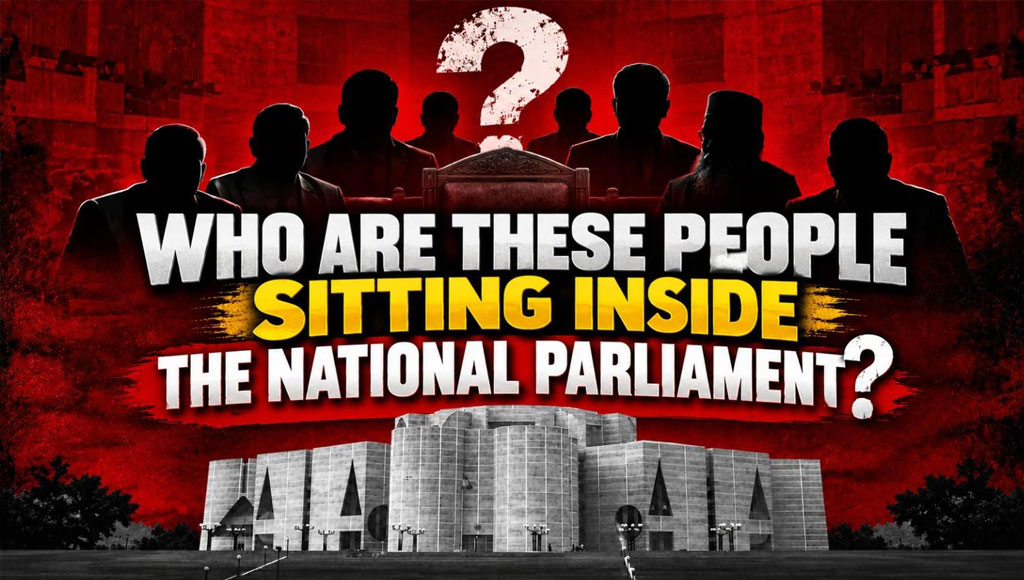
Who are these people sitting inside the National Parliament?

The very parliament that makes laws for the country. Who are these people sitting there as lawmakers? Trying to find the answer is enough to make your head spin. Nearly three dozen lawmakers from the BNP and Jamaat have been convicted by court verdicts, with some having received the harshest penalties prescribed by law.

Let us begin with the biggest names. Prime Minister Tarique Rahman, MP for Dhaka-17. He was sentenced to life imprisonment on October 10, 2018, in the August 21 grenade attack case. In addition, his name is associated with a seven-year sentence and a Tk 20 crore fine in a money-laundering case, 10 years in the Zia Orphanage Trust case, nine years in an illegal-assets case, and two years in a defamation case.

In the same grenade attack case, Lutfuzzaman Babar, MP for Netrokona-4, was sentenced to death. He also received a death sentence and life imprisonment in the 10-truck arms case, 17 years for illegally possessing firearms at his residence, and eight years in a corruption case.

Abdus Salam Pintu of Tangail-2 was also sentenced to death in that case in 2018, while Kaykobad of Cumilla-3 received life imprisonment. Can you imagine so many sitting MPs being implicated in the same case?

When we turn to Jamaat, the picture becomes even more disturbing. A.T.M. Azharul Islam of Rangpur-2 was sentenced to death in December 2014 in a case involving crimes against humanity committed in 1971. So many years after the Liberation War, it is difficult to accept the reality that a person convicted of war crimes is now a member of parliament.

Shahjahan Chowdhury of Chattogram-15 also has a judgment dated April 12, 2008, under which he was sentenced to 10 years in prison for corruption involving duty-free vehicles and concealing information about his assets.

Amanullah Aman of Dhaka-2 was sentenced to 13 years in 2007 in a case involving illegal assets and concealment of information. He also has a seven-year conviction for extortion.

Iqbal Hasan Mahmud Tuku of Sirajganj-2 received a nine-year sentence, while Mir Helal Uddin of Chattogram-5 received three years.

Salahuddin Ahmed of Cox’s Bazar-1 received seven years in a bribery case, and separately 13 years in an illegal-assets case, along with a Tk 2 crore fine and an order for confiscation of his property.

Hafiz Ibrahim of Bhola-2 was sentenced in 2008 to 13 years in prison and fined Tk 1 crore. Ali Asgar Lobi of Khulna-5 also received 13 years and a Tk 10 lakh fine.

Rashiduzzaman Millat of Jamalpur-1 received eight years. Zahid Hossain of Dinajpur-6 received 13 years and a Tk 10 lakh fine.

The sentence imposed on Wadud Bhuiyan of Khagrachhari was a full 20 years, along with a Tk 10,000 fine.

Naser Rahman of Moulvibazar-3 received nine years for extortion and, in a separate illegal-assets case, 13 years and a Tk 5 lakh fine.

Ariful Haque Chowdhury of Sylhet-4 received a 10-year sentence.

And the list does not end there.

Mirza Abbas Uddin Ahmed of Dhaka-8 was sentenced to eight years in prison in a judgment dated May 11, 2008, for tax evasion and providing false information in his income-tax return.

Mizanur Rahman Minu of Rajshahi-2 received a sentence of 13 years and one month in cases involving extortion, vandalism and looting.

Ruhul Quddus Talukder Dulu of Natore-2 was sentenced to 12 years under the Explosives Act and seven years in a separate case.

Nurul Islam Moni of Barguna-2 was sentenced to 14 years in a corruption case in 2007.

Hafiz Uddin Ahmed of Bhola-3, who is now the Speaker of Parliament, also has a record of a 13-year prison sentence in a judgment dated June 19, 2008, in a case involving the acquisition of illegal assets and concealment of information. The person presiding over Parliament has such a verdict recorded against his name.

Beyond that, four cases are pending against Tamiz Uddin of Dhaka-20. Khairul Kabir Khokon of Narsingdi-1 has a history involving a 2011 murder case and arson cases from 2016–17.

Dewan Salahuddin of Dhaka-19 was arrested and remanded in cases involving sabotage, vandalism, arson and explosives in 2015.

Alamgir Mohammad Mahfuzullah Farid of Cox’s Bazar-2 has criminal records involving the Anti-Corruption Commission and RAB from 2007 to 2019.

And Abul Khayer Bhuiyan of Lakshmipur-2 has a case record dating back to 2008 involving the misappropriation of rice.

Are you thinking these are all stories from the distant past? Not at all.

These names also appear repeatedly in the cases stemming from the street protests of 2023.

Hafiz Uddin of Bhola-3 and Altaf Hossain Chowdhury of Patuakhali-1 were sentenced to 21 months in December 2023 in cases involving obstruction of police duties.

Sultan Salahuddin Tuku of Tangail-5 received a two-year sentence in a Paltan Police Station case, although another source reports the sentence as three years.

Azizul Bari Helal of Khulna-4 received two years in a Paltan case and one and a half years in a separate New Market case.

Habibur Rashid Habib of Dhaka-9 received sentences of two years, three years and two and a half years in three separate cases.

Rajib Ahsan of Barishal-4 received two years in a Paltan case and two years and three months in a Ramna case.

Sheikh Rabiul Alam of Dhaka-10 received two and a half years in a Kalabagan case and three years in a Dhanmondi case.

S.M. Jahangir Hossain of Dhaka-18 received two and a half years in a case filed with Uttara East Police Station.

Shahidul Islam Babul of Faridpur-4 received sentences of two and a half years and one year in separate Paltan cases.

Shafiqul Islam Masud of Patuakhali-2 received three years in a Dhanmondi case involving the setting fire to a bus.

Mohammad Shahjahan of Noakhali-4 received four years in prison and a Tk 10,000 fine in a case filed with Vatara Police Station involving arson and obstruction of police duties.

Giasuddin Quader Chowdhury of Chattogram-6 received three years and a Tk 5,000 fine in a case involving threatening statements about Sheikh Hasina.

Rafiqul Islam Khan of Sirajganj-4 received a three-month sentence for contempt of court.

And Abu Said Chand of Rajshahi-6 received three years in a case involving fraud and embezzlement of money by promising to provide jobs.

Reading this list is enough to leave one breathless.

Yet these are the people now sitting in Parliament. These are the people deciding the direction in which the country will move.

People with court convictions involving murder, weapons, money laundering, corruption, extortion and arson are now entrusted with making the country’s laws.

If Parliament itself looks like this, then what value does the law have in the eyes of a police station officer-in-charge, a political cadre on the ground, or an extortionist in the marketplace?

From 2001 to 2006, the country witnessed how violence and plunder could spread under the protection of those in power. The old circus has begun again.

And the people at the top of the party cannot be left out of the discussion either.

Mirza Fakhrul Islam Alamgir is now the President, while a convicted person like Gayeshwar Chandra Roy now holds the rank of a minister as an adviser to the Prime Minister.

The entire structure stands under the shadow of this leadership, where a history of criminal cases and convictions appears to circulate almost like a qualification.

After coming to power, the BNP and Jamaat have used political influence to bring the judiciary in line with their interests and have suppressed allegations against their own leaders.

The question, therefore, is not simply who was convicted and what sentences they received.

The question is this: In a country where a procession of people with such criminal records enters Parliament, where will ordinary citizens look for security and justice?

আরো পড়ুন

LATEST